Llwynberried Farm/ Beef Farm Visit

Hay festival has been and gone and I feel I’m leaving a little enlightened as always. There were a few particularly relevant events which I ended up stewarding for which I’ll be writing about over the next few days.

Llwynberried Farm/ Beef Farm Visit

I feel that it is important if you are going to talk to anyone about being vegetarian/ vegan, which if you are one and ever leave the house you will, to get some basic facts right before you start. So this tour of a farm was a great opportunity to find out some facts to give my opinions some weight. It was interesting but very saddening to hear a beef farm talked about from a farmers perspective for a change.

So here I am in as an unbiased fashion as possible recounting some facts given to me.

The first and most frequently mentioned points were about the sustainability of beef farming. The farmers point was that they grow the food for the cows, (including wheat, barley, oilseed rape and forage maize,) which they then feed to the cows, which then poo, which is used for fertiliser. I am more than a little suspicious of this as the farmer still had to buy in supplement foods and fertiliser.

The farmers pointed out that the grass which cows feed on are carbohydrates which humans, chickens and pigs can’t digest but cows can.
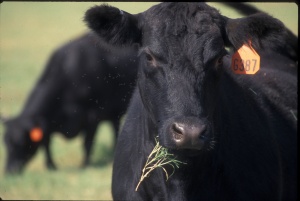
cows2(Image from clemsonresearchfarms) 

Interestingly the sweet smell of dried grass or hay in farmyards is lactic acid.

This year especially with all of the bad weather the farmers are running out of food early and so will have to send the cows off to slaughter earlier than they usually would.

Female cows can eat up to 4k of grass per day. This is the least economic change from feed to meat. In late life a male cow will put on 1.6k every day.

Beef takes up to 7k of feed to make only 1k of meat.

Chickens eat up to 4k of feed to make 1k of meat.

I have in my notes the words block grazing, so I assume this is how this farm manages its grazing. Block grazing is where a heard of cows are placed in a small segment of field to graze all of it before being moved to another section.  Each cow needs 2 acres of space.

When a calf is born it spends 6 months with its mother. It is then weaned off and taken to grass or the food lots. A male calf will live on average 16 months.  If a cow was allowed to live a full life outside of farming it would live between 15-20 years.*

Female cows live longer. They are allowed to live on average 10/11 years until they are either injured or stop breeding. A cow can begin to reproduce from around 6-9 months of age. She will have one calf a year. A cow will spend 6 months feeding her young, followed by 3 months of rest before being put out with a bull again.

So what’s the difference to a farmer between organic and non-organic? In a non-organic farm you can vaccinate cows against disease, use nitrogen fertilisers and chemicals to control weeds. You can’t do any of these things in an organic farm.
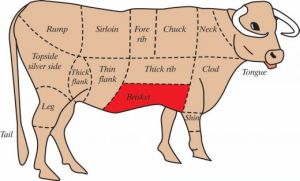
694640_f520(image from masterman535hubpages)

So there we are, the main thing I took away from this visit is the lack of empathy within the industry for creatures.

The bulls were all ‘in to feed’, meaning in a barn, while the cows and calves were in a small mud pen during our visit. Though we could get up close and personal with their faces, the farmers spoke of the cows wholly as a product or food and at no point as an animal. At the end of the tour and talk almost all visitors tucked into a beef burger from the farm, and were told the date of it’s death. Still, if you’re going to eat it you should look into its eyes first.

*This point was not made at the talk but I felt I should add it to provide some balance here. To get this figure I simply Googled life span of a cow and used the average of all of the results.


Food Safety L2.

So I’ve been on a food hygiene course run by the tourism training in Cardiff.

Just want a short RAGHGH…. Food was provided for this day-long course. Though we (Wales Outdoors) informed them that there would be one vegetarian and one vegan attending there was minimal provision for vegetarians (cheese sandwiches) and next to none for vegans. Which meant I survived the day on my three allocated wedges and mixed salad leaves, it doesn’t take much effort to say ok can you bring a packed lunch along then.

Anyway I thought it would be useful to write a bit of a summary here. The rules and guidelines are aimed at commercial cooking not home cooking, but some of this stuff is useful to know anyway.

BASICS/ TERMINOLOGY;
Hazard – the potential to cause harm.
Risk – the likelihood to cause harm.
Control – how to reduce the risk.
Diligence – keep up to date records of temperatures, training, and where you source food.
BACTERIA;
Is the cause of 97% of food related illness, luckily the best way to kill bacteria is to cook it.
There are two types of bacteria;
SPOILAGE BACTERIA – this causes food to go off.
PATHOGENIC BACTERIA – these are the harmfull bacteria that cause illness.
-it is not possible to see or smell the presence of these.
PATHOGENS INCLUDE; Samonella, Campylobacter, Botulism, Ecoli, Listeria, Staph, Bacilus Cereus.
Us veggies are lucky that most are commonly found in meat but;
• Botulism is most commonly found in tinned food. This doesn’t need oxygen to survive. (Important to know about the controls for this if you can your own food.)
• Ecoli can be found in contaminated water.
• Listeria is found in unpasteurised dairy and sometimes salads. This will still live in fridges.
• Staph lives on people and animals and is passed on by coughs, sneezes etc. (Why you shouldn’t cook for others when you’re ill.)
• Bacillus Cereus is mainly found in rice and pulse dishes. This survives heating. (Why you shouldn’t reheat your takeaway rice.)

For bacteria to grow it is essential they have;
• Water
• The right Temperature
• Food
• Time

VIRUS;
Are different from bacteria.
They do not depend on food or water and cannot live on dead bodies. So they rely on carriers i.e. humans, animals such as pets, rats, birds, insects.
It is possible for viruses to not show symptoms, this makes you a carrier.
TEMPERATURES;
To check temperatures keep a thermometer in the middle of the fridge/ freezer, check food temperature at it core.
For food to be safe to eat the core temperature should be 70c for 2 minutes.
Bacteria begins to be destroyed above 63c.
The danger zone when bacteria are most active is between 63c – 5c. Food should not be at this temperature for more than 90 minutes.
The ideal temperature for bacteria is 37c.
The highest temperature a fridge should be is 8c.
The target temperature for a fridge is 1c- 4c.
The closest to 0c a freezer should get is 18c. Under this bacteria are dormant.
(To help food cool down more quickly chop it into smaller pieces.)

CONTAMINATION;
Contamination is the presence of any harmful substance or object in food.
This can be;

Microbial – living objects, bacteria.
Physical – Objects like plasters
Chemical – such as pesticides, or residues.
Cross contamination occurs where raw food touches cooked food or between different types of food ie; dairy and vegetables, meat and dairy etc.
Cross contamination can occur due to direct contact where the food actually touches each other. Or indirect contact where hands, utensils, wash cloths touch one food then another.
Chopping boards, our hands and cloths used to wipe surfaces are areas to watch.

HACCP;
Hazard Analysis of Critical Control Points.
This means identifying hazards and implementing controls.
Critical control points are where things can go wrong- storage, preparation, cooking and delivery.
HIGH RISK FOOD;
Good news again for us veggies high risk foods are high protein, high moisture and ready to eat.
High protein foods are animal products, rice and tofu.
Sweet or salty food is less high risk as salt and sugars work as preservatives.
Important controls include; Cleaning, disinfection, hygiene, personal and kitchen, well maintained kitchen, control of clothing, good stock rotation, reducing risk of pests, keeping foods at correct temperatures.
(water above 82c will disinfect.)

Boozy Risotto

Risotto is one of my favourite foods to cook, it’s so relaxing and fulfilling just hanging out in the kitchen stirring a big pan of cooking rice, of course with a suitably big glass of wine in hand. This is a great one to cook for a few friends if they like hanging out in the kitchen while you work. Of course the other great thing is it’s versatility, mess around with the ingredients. Make it fresh, boozy or creamy depending on you’re mood.

IMG_1145

Ingredients;

  • arborio (risotto) rice
  • 4 asparagus
  • 3 cloves garlic
  • 4 button mushrooms halved
  • 2 small carrot
  • 2 celery
  • 1 onion
  • handful broad beans
  • handful peas
  • several handfuls baby leaf spinach
  • 1 tbsp swiss vegetable bouillon (stock)
  • 3 cherry tomatoes per plate
  • 1 kettle full of boiled water
  • 1 large glass red/ white wine – I like the flavour of red better but it makes the rice a funny colour purple.

1. Chop all of your ingredients, hard veg like carrots or squash very small.

2. Pour a little oil on the tomatoes and coat, place in the oven check every 10 minutes or so until they are browning and skin split. Remove from oven.

3. With a small amount of butter in a heavy saucepan or wok, fry the onions, celery, mushrooms and garlic for a few minutes.

4. Add the carrots, or hard veg, then the rice, stir thoroughly.

5. Add the stock then add the water about half a cup at a time. Stirring each time constantly until it’s all absorbed. Then add the next half cup.

6. When the rice has started to expand and you think it is about half way to done add the asparagus and broad beans. Continue adding the water a half cup at a time and stirring.

7. When it’s almost done add the peas. Don’t forget to put the tomatoes in to heat back up if they came out early.

8. When you think it’s completely done (the water is absorbed, the rice thick and creamy, not hard in the middle) add the glass of wine.

9. Stir until it is all absorbed, add the spinach, mix to wilt and serve with the tomatoes on top.

(The step in bold I am convinced is the secret to great risotto, along with using a good stock.) =p


Greggs Vegetable Pasties Ingredients

Because my partner insisted on eating Greggs Vegetable Pasties until I could prove they weren’t vegan I wrote to them to find out.

Greggs

Here are the messages back with the list of ingredients. =)

Dear Rebecca

Thanks for taking the time to get in touch about our Vegetable Bakes.
As we have a large range which changes from time to time, we’ve chosen not to put ingredients on line and in our shops.  However our Shop Team should be offering to give us a call to find any information out for you.  I’m sorry that this hasn’t been the case on your recent visits.
As we’ve two different types of Vegetable Bake can you please tell me which shop you usually visit so I can give you the correct information?

I hope to hear from you soon.

Kind regards

Stephanie Mogie
Customer Care TeamDear Rebecca
Thanks for getting back to us.

I’ve spoken to the shops you mentioned and these sell the vegetable pasty with the below ingredients in:

Pastry: Wheat Flour, Vegetable Margarine and Shortening (contains: Palm and Rapeseed Oil, Water, Salt, Emulsifier: Mono- and Diglycerides of Fatty Acids), Water, Salt.
Filling (48%): Water, Dried Vegetable Mix (contains: Potato, Onion, Carrot, Rapeseed Oil, Yeast Extract, Salt, Vegetable Bouillon (Sea Salt, Potato Starch, Yeast Extract, Palm Oil, Vegetables, Maltodextrin), Stabiliser: Hydroxypropyl Methyl Cellulose; Celery and Pepper Extracts), Carrot (9%), Onion (7%), Peas (4%), Green Beans (3%), White Pepper, Mixed Herbs (contains: Marjoram, Basil, Oregano, Sage, Thyme, Parsley), Salt.
Glaze: Water, Rapeseed and Sunflower Oil, Modified Maize, Potato and Tapioca Starch, Milk Proteins, Skimmed Milk Powder, Emulsifiers: Mono- and Diglycerides of Fatty Acids, Mono- and Diacetyl Tartaric Acid Esters of Mono- and Diglycerides of  Fatty Acids; Stabilisers: Cellulose, Carboxy Methyl Cellulose, Carrageenan; Acidity Regulators: Sodium Phosphates; Colour: Mixed Carotenes.

With regard to how we know which is which, the two vegetable pasties we sell have different marking on, so the one you get in the shops you visited has a small dent in the middle of it, the other has lines across it. All of our Savouries, have different markings on so our Shop Teams can tell which is which without having to look at the tickets.

I hope this has been of help and if you need anything else please don’t hesitate to contact us Rebecca.

Remember to quote your call reference number: F1390146 in any
correspondence, as this will assist us in providing you with a
quick response.

Kind regards

Carrie Veitch
Customer Care Team

Tomato and Bean Pasta Bake

It’s a long list of ingredients but it’s also deliciously good for you, filling, easy to make large amounts of and pretty to look at too. Great cold the next day!

IMG_1263

Ingredients;

Base;

  • 4 handfuls Pasta
  • 1 carton Tomato pasta
  • 6 cherry tomatoes
  • 6 plum tomatoes
  • 6 sun dried tomatoes
  • 1 courgette
  • 1 onion
  • 4 garlic cloves
  • 1 red pepper
  • 1 tin pre-cooked/ tinned red kidney beans
  • 1 tin pre-cooked/ tinned butter beans
  • 1 tin sweetcorn
  • 1 tsp Marmite
  • 1 tbsp dried herbs
  • 1 tbsp ground chilli

Crumb Topping;

  • 2 tbsp ground flack seed
  • 1 handful mixed seeds
  • 1 handful mixed chopped nuts
  • 1 slice bread – crumbed

Creamy Sauce;

  • 1 tbsp mustard
  • 1 tbsp swiss vegetable bouillon (stock)
  • 1 to 2 cups vegan milk
  • 100g vegan butter
  • 100g vegan flour

1. Boil the pasta to al-dante. Drain, mix in a small piece of butter and set aside.

2. Meanwhile, chop the onion, courgette, pepper into bite size chunks, slice the garlic, half the tomatoes and slice the sun-dried tomatoes.

3. Fry the onions and courgette, when the onion is beginning to look see-through add the garlic and pepper. Stir frequently.

4. Add the tomatoes, tomato sauce, Marmite, dried herbs and chilli.

5. Finally when beginning to boil add the beans and set aside.

6. Put the ground flack seed, nuts, seeds and bread crumbs in a bowl and mix, set aside.

7. In a saucepan gently melt the butter.

8. Add the flour and stir until thoroughly combined.

9. Add the milk a little at a time, stirring. Add the mustard and stock. Set aside.

10. Mix the pasta and sauce together. Pour into a big casserole dish.

11. Pour over the creamy sauce.

12.Sprinkle on the crumb topping.

13. Oven cook for about 20 minutes at 180 until the topping is golden and inside bubbles.


Served with garlic bread and plain rocket salad.

The Virgin Bloody Mary Smoothie

So basically I thought that a Bloody Mary is a pretty epic drink. Lots of tomatoes, some celery, a bit of spice to make it exciting, what could make a greater breakfast smoothie… and yes it does make a great smoothie, though a whole pint was way too much! =)

AgfaPhoto Ingredients;

3 garden tomatoes

8 cherry/ plum tomatoes

1/4 cucumber

1 celery stick + sticks to garnish

1 or 2 drops of tabasco sauce

1 or 2 drops of vegan Worcester sauce or soy sauce

salt

pepper

This makes quite a lot.

Blend all of the ingredients, taste add more tomatoes/ cucumber/ flavourings to taste. Garnish with celery.

This Weekend;

Some things not to miss this weekend;

Bristols big vegetarian/ vegan food festival, Vegfest, started today finishes Sunday.

Hay-on Wye Literature Festival is going on all weekend and the following week.

And while I’m reminding you of stuff Cardiff’s Vegetarian Festival has finally settled on a date this year, 15th June.

On the same day One Planet Cardiff Festival will be on celebrating sustainable living.

Pea and Broad Bean Bruschetta

Summery, Fresh, Green, mmm. Great on toast, jacket potatoes or crumpets.

AgfaPhoto

  • Big handful garden peas
  • Big handful broad beans
  • Big handful baby spinach leaves
  • 2 garlic cloves
  • 1/2 lemon juice
  • Olive oil
  • Salt/ pepper

1. Remove half of the skins from the broad beans – this will give the bright green colour.

2. Cook the beans until soft, add the peas at the last minute just to defrost.

3. Blend the beans, spinach, garlic, lemon, oil and seasoning to a paste.

4. If spreading on toast re-heat under grill for a few seconds before eating.

The Most Chocolaty Hot Chocolate

AgfaPhotoHow do you make a super rich creamy chocolaty hot chocolate? Italian Style

Ingredients;

1 bar vegan chocolate

1/2 cup of nut milk

1/2 mini carton vegan cream

almond essence/ mint extract/ a vegan cream liqueur (all optional- probably don’t use all of them at once!)

mint leaves (optional)

1. Melt half a bar of vegan hot chocolate over a very LOW heat in a saucepan.

2. Add nut milk slowly a little at a time.

3. Add some vegan cream, cocoa power and sugar, continue to stir.

4. Add  a drop of almond essence/ grated almond or mint ((optional)- if using liquor pour it in with the cream at no.6.).

5. When it tastes perfect and is a great thick but drinkable consistency pour into a cup. – Not too much its super rich!

6. Decorate; Pour in a little vegan cream, tear a few mint leaves and grate a square of chocolate.